

Peer-reviewed publications and FDA pivotal study data supporting clinical use.
FDA-Cleared • AI-Powered • Point of Care
Skin cancer detection in rural clinics and FQHCs
DermaSensor supports skin cancer detection in rural clinics, so suspicious lesions can be evaluated during routine visits, with an objective risk result at the point of care.

Skin concerns are often raised toward the end of visits scheduled for other medical issues. In rural communities, the high burden of skin disease, logistical barriers to specialty care, and shortage of dermatologists place an increased burden on primary care providers to provide dermatologic care.1
In the absence of objective assessment tools, primary care providers often rely largely on visual examination alone, creating challenges at both ends.
Given the uncertainty inherent in evaluating skin lesions without specialized dermatologic expertise, clinicians may refer broadly, potentially subjecting patients with ultimately benign lesions to lengthy travel and prolonged waits while further increasing demand on already limited dermatology services. Conversely, a more selective referral approach risks missing or delaying the evaluation of concerning lesions.
The DermaSensor device provides an objective assessment of skin cancer risk immediately at the point of care, giving providers greater clarity when determining appropriate next steps. This page outlines how DermaSensor can integrate into rural clinic workflows, the clinical evidence supporting its use, and how adoption aligns with the priorities of the Rural Health Transformation Program.

Quick answer: skin cancer detection in rural clinics
-
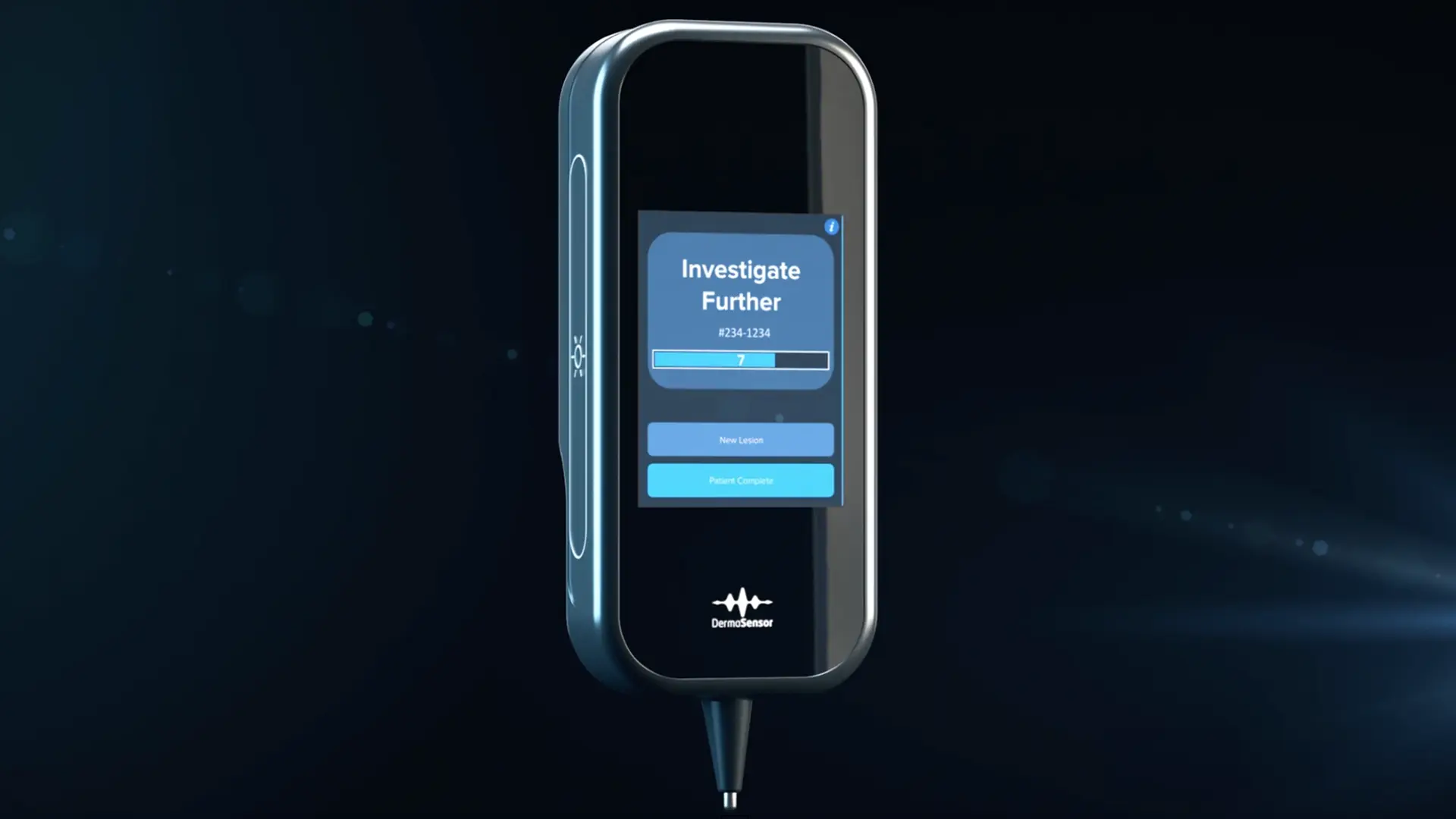
Suspicious lesions are evaluated during the visit. Two outputs at the point of care: "Investigate Further" or "Monitor", with a 1 to 10 spectral score on Investigate Further results to support referral prioritization.
-
In the DERM-SUCCESS pivotal study, device sensitivity was 96.3% in patients aged 40 years and older, the FDA-indicated population.
-
No procedure-room setup and no up-front capital expense.
-

No training seminars or courses needed, just minutes of reading the device Instructions for Use.
DermaSensor is an adjunctive device for use by non-dermatology providers, FDA Cleared for lesions suggestive of melanoma, basal cell carcinoma, or squamous cell carcinoma in patients aged 40 and above. It is not intended to provide a diagnosis.
DermaSensor in numbers
*Clinical evidence upon request.
-
52%
relative decrease in primary care physicians' missed skin cancer referrals, from 18.0% to 8.6%
-
20.7%
of suspicious lesions biopsied by primary care physicians correctly classified as benign
-
40%
of the US population lives in areas with limited access to a dermatologist
-
First
FDA-cleared skin cancer device developed for primary care physicians
Why does skin cancer go undetected in rural primary care?
Skin cancer goes undetected in rural primary care because providers who are managing the burden of dermatologic disease often have the least access to specialist support. As a result, access to dermatology in rural areas is constrained by prolonged wait times, greater travel demands, and a relative shortage of dermatologists compared with urban areas.1
The clinical workload has grown alongside that gap. Skin cancer prevalence in the United States is rising, particularly in rural communities, where occupations such as agricultural work and construction bring heavy sun exposure.1 Meanwhile, dermatology training for primary care physicians consists primarily of pre-clinical exposure, with a relative lack of opportunity for further postgraduate dermatology training.1
The resulting diagnostic uncertainty has consequences in both directions. A meta-analysis of 29 studies encompassing more than 398,000 biopsies found that more than twice as many biopsies were needed to detect a single melanoma in primary care compared with dermatology settings.3 This reflects a difficult balance: concerning lesions may go unrecognized, while limited dermatology capacity is simultaneously consumed by lesions that ultimately prove benign.

Extending skin cancer assessment into rural care
-
Assessment without referral
Clinicians can evaluate suspicious lesions during routine visits, so patients receive an objective assessment without traveling to a specialist or waiting for an appointment.
-
Prioritized referrals
Objective spectral data helps clinicians identify which lesions warrant urgent specialist evaluation and which can be monitored, directing limited regional dermatology capacity toward the patients who need it most.
-
Reduced patient burden
For patients facing long travel distances, lost working hours, or the cost of a specialist visit, an in-office assessment removes barriers that can otherwise prevent a referral from being acted on.
-
Practical adoption
The device requires no procedure-room setup and no up-front capital expense. There are no training seminars or courses needed, just minutes of reading the device Instructions for Use, which supports adoption in settings with rotating providers or locum coverage.
By bringing lesion evaluation into routine rural care, DermaSensor helps expand access to skin cancer risk assessment while supporting timely referral pathways for the patients who need specialist attention.
How does DermaSensor support skin cancer detection in rural clinics?
Rural clinics and health centers are often short staffed, and absorbing a new workflow that demands special site preparation or specialty training is frequently not possible. The DermaSensor device was designed with that constraint in mind. It does not require a change to clinical practice. It adds objective information to an assessment clinicians are already making.
The handheld device is applied directly to the suspicious lesion and takes five recordings, each of which takes a non-invasive sample of lesion tissue. The algorithm analyzes the spectral data and returns one of two results: “Monitor” or “Investigate Further.” An “Investigate Further” result is accompanied by a score from 1 to 10 reflecting the degree of spectral similarity to malignant lesions in studies. There is no tissue removal, no incision, and no specimen collection.
Clinical evidence supporting DermaSensor device use
DermaSensor has been evaluated in prospective, multi-center studies conducted in primary care settings. In the DERM-SUCCESS pivotal validation study, which enrolled 1,579 lesions across 22 primary care sites, device sensitivity was 96.3% in patients aged 40 years and older, the FDA-indicated population, and 95.5% across all ages.2 Device specificity was 20.7%, i.e., the device correctly classified as benign 20.7% of lesions that the PCPs biopsied.2
In the companion multi-reader multi-case utility study, primary care physicians’ management sensitivity increased from 82.0% without the device to 91.4% with it, and their false negative rate decreased by more than half, from 18.0% to 8.6%.5
For rural clinics these findings matter together rather than separately. Improved detection is the clinical case. Sending fewer benign lesions down a long referral pathway protects the specialist capacity a region already has and spares patients long journeys they did not need to make.

How DermaSensor fits Rural Health Transformation Program funding
The Rural Health Transformation Program is a $50 billion, five year federal initiative administered by the Centers for Medicare and Medicaid Services. CMS announced awards to all 50 states in December 2025, and funding runs through 2030.6
Because states retain discretion over how those dollars reach providers, eligibility and process vary by state. Clinics and health centers pursuing RHTP support are generally competing within their own state’s distribution process rather than applying to CMS directly, and the relevant deadlines are set at state level.
Requirements vary between states, so the practical first step is a conversation about the relevant process.

DermaSensor is an FDA Cleared device rather than an investigational one, which matters for a funding submission. It can support applications under categories that appear commonly across state plans:
- Technology-driven solutions for the prevention and management of chronic diseases
- Investment in technologies that promote efficient care delivery and access to digital health tools by rural facilities and providers
- Payments to health care providers for the provision of health care items or services
- Measurable, outcomes-driven interventions with trackable data
There is no up-front capital purchase requirement or procedure-room setup, simplifying the implementation process and how deployment is presented in a funding request, while also allowing outcomes to be reported quicker.
A funding case can also be built around capacity rather than equipment: fewer benign lesions traveling to a distant dermatologist allows a region’s existing specialist capacity to extend further without additional staffing.

Clinical Evidence Package
DermaSensor can support clinics building their case with:
Implementation Support: Clinical training and guidance for integrating the device into existing workflows.
Outcomes Reporting Tools: Data collection and reporting frameworks to support evaluation.
Partnership Documentation: Materials to support collaborative funding applications and partnership submissions.
Requirements vary between states, so the practical first step is a conversation about the relevant process.
Talk to us about RHTP fundingMeasuring outcomes for RHTP reporting
RHTP subawards generally carry performance reporting obligations, and routine device use generates structured data that can support them.
Device use generates a structured record for each lesion scanned, including the device result and spectral score, which can be combined with practice data to support measurement across areas that map to common rural health reporting priorities:
- Missed skin cancers and cancer stage at diagnosis
- Referral appropriateness, measured as the proportion of referrals resulting in a confirmed malignancy
- Unnecessary biopsy rate, measured as the proportion of biopsied lesions found to be benign
- Time from initial visit to referral, to specialist assessment, to biopsy, and to treatment
- Clinician confidence before and after device adoption
Measured before and after device adoption, this produces a reporting record across the life of a multi-year award rather than a single snapshot.
Built for the rural care setting
FAQs
About DermaSensor use in Rural Health and FQHCs
Can rural health clinics and FQHCs use DermaSensor?
Yes. DermaSensor is indicated for use by physicians who are not dermatologists, which includes primary care physicians working in rural health clinics, hospitals, federally qualified health centers, and community health centers. The device is used on lesions already assessed as suspicious for skin cancer, in conjunction with the clinical assessment.
Does DermaSensor require a dermatologist on site?
No. The DermaSensor device was developed specifically to support clinicians who are not dermatology specialists. It provides objective information to inform the decision about whether to refer a patient, and it is not intended to provide a diagnosis.
Can Rural Health Transformation Program funds be used for a device like DermaSensor?
RHTP funds are awarded to states, which then decide how the money reaches providers. Eligible uses commonly include technology that supports prevention and improves care delivery and access in rural settings. Whether a specific purchase qualifies depends on the state’s approved plan and its distribution process, so the state program office is the appropriate first point of contact.
How much training does DermaSensor require?
There are no training seminars or courses needed, just minutes of reading the device Instructions for Use. That is a practical consideration for clinics with rotating providers or locum coverage.
What does DermaSensor cost for a rural clinic?
DermaSensor is offered on a subscription basis rather than as an up-front capital purchase, which can suit clinics with constrained equipment budgets or grant-funded timelines. Pricing depends on the number of devices and the deployment, so our team will walk through options on a demo call.
Indications for Use
The DermaSensor device is indicated for evaluating skin lesions suggestive of melanoma, basal cell carcinoma, and/or squamous cell carcinoma in patients aged 40 and above, to assist in the decision to refer the patient to a dermatologist. The DermaSensor device should be used in conjunction with the totality of clinically relevant information from the clinical assessment, including visual analysis of the lesion, by physicians who are not dermatologists. The device should be used on lesions already assessed as suspicious for skin cancer and not as a screening tool. The device should not be used as the sole diagnostic criterion nor to confirm clinical diagnosis of skin cancer.
References
- Johnson MC, Patel P, Ayers A, Spears KM. Resource Management Challenges in Rural Dermatological Care: A Mapping Review. Cureus. 2025;17(1):e77544. doi:10.7759/cureus.77544. Available at: https://doi.org/10.7759/cureus.77544
- Merry SP, Croghan IT, Dukes KA, McCormick BC, Considine GT, Duvall MJ, Thompson CT, Leffell DJ. Primary Care Physician Use of Elastic Scattering Spectroscopy on Skin Lesions Suggestive of Skin Cancer. Journal of Primary Care & Community Health. 2025;16:21501319251344423. doi:10.1177/21501319251344423. Available at: https://doi.org/10.1177/21501319251344423
- Petty AJ, Ackerson B, Garza R, Peterson M, Liu B, Green C, Pavlis M. Meta-analysis of number needed to treat for diagnosis of melanoma by clinical setting. J Am Acad Dermatol. 2020;82(5):1158-1165. doi:10.1016/j.jaad.2019.12.063. Available at: https://doi.org/10.1016/j.jaad.2019.12.063
- U.S. Food and Drug Administration. De Novo Classification Request: DermaSensor (DEN230008). January 12, 2024. Available at: https://www.accessdata.fda.gov/cdrh_docs/pdf23/DEN230008.pdf
- Ferris LK, Jaklitsch E, Seiverling EV, Agresta T, Cyr P, Caines L, Wang N, Siegel DM. DERM-SUCCESS FDA Pivotal Study: A Multi-Reader Multi-Case Evaluation of Primary Care Physicians’ Skin Cancer Detection Using AI-Enabled Elastic Scattering Spectroscopy. Journal of Primary Care & Community Health. 2025;16:21501319251342106. doi:10.1177/21501319251342106. Available at: https://doi.org/10.1177/21501319251342106
- CMS Announces $50 Billion in Awards to Strengthen Rural Health in All 50 States. Centers for Medicare and Medicaid Services. December 29, 2025.
80-0009.29