
Real-World DermaSensor Results in Primary Care

A clinical registry case study from Montgomery Medical, Inc.
This page reports real-world DermaSensor results from Montgomery Medical, a two-physician primary care practice in Pennsylvania. Over 12 months of device use, the practice recorded 8.5 times more pathology-confirmed skin cancer diagnoses, a 10.1 times improvement in diagnostic yield, and 33% fewer monthly dermatology referrals.*
Drs. Marcy Goisse and Betty Thomas compared 12 months of practice data before DermaSensor was introduced with the subsequent 12 months of device use.
Key Takeaways: DermaSensor Results in a Real-World Primary Care Practice
- 8.5X more skin cancers diagnosed: 2 before device implementation compared with 17 during the device-use period.*
- 10.1X higher diagnostic yield: the proportion of further investigated lesions confirmed as cancer increased from 2.8% to 28.3%.*
- 33% fewer dermatology referrals: average referrals decreased from 1.5 to 1.0 per month.*
- 125 lesions evaluated with DermaSensor during the 12-month device-use period.*
- No lesion classified as “Monitor” was subsequently found to be malignant in this registry.*
- The observed cancer rate increased with the DermaSensor spectral score: 0% for scores 1-3, 14% for scores 4-7, and 56% for scores 8-10.*
- In the DERM-SUCCESS pivotal study, device sensitivity was 96.3% in patients aged 40 years and older, the FDA-indicated population.1
- DermaSensor is an adjunctive device for use by non-dermatology providers, FDA Cleared for lesions suggestive of melanoma, basal cell carcinoma, or squamous cell carcinoma in patients aged 40 and above. It is not intended to provide a diagnosis.2
*Results reflect a single-practice clinical registry and should not be interpreted as outcomes that will occur in every practice.
What Happened When a Primary Care Practice Adopted DermaSensor?
The Montgomery Medical registry compared two 12-month periods: one before DermaSensor was implemented and one after the device became part of the practice’s approach to suspicious skin lesions.
During the pre-device period, 71 lesions underwent further evaluation and 2 were confirmed as malignant, giving a diagnostic yield of 2.8%. During the device-use period, 60 lesions underwent further evaluation and 17 were confirmed as malignant, increasing diagnostic yield to 28.3%. That meant 8.5 times more skin cancers were diagnosed even though fewer lesions were further evaluated. The diagnoses were confirmed by pathology following further investigation of the lesions.
How Much Did Skin Cancer Diagnostic Yield Improve With DermaSensor?
In the Montgomery Medical registry, skin cancer diagnostic yield increased from 2.8% to 28.3%, a 10.1 times improvement. Diagnostic yield measures how often a lesion sent for further investigation is ultimately confirmed as cancer.
For a primary care practice, the finding is notable because the increase in confirmed cancers did not come from sending more lesions for further investigation. Fewer lesions were further evaluated during the device-use period, while substantially more cancers were identified.
Did Dermatology Referrals Increase or Decrease With DermaSensor?
In the Montgomery Medical registry, average dermatology referrals decreased 33%, from 1.5 per month before DermaSensor implementation to 1.0 per month during device use. At the same time, the number of diagnosed skin cancers increased from 2 to 17.
The registry authors concluded that the additional cancers identified reflected changes in lesion management and skin-examination frequency rather than an increase in dermatology referrals.
These are findings from Montgomery Medical and should be viewed as real-world practice experience, rather than as evidence that every practice using DermaSensor will experience the same change in referral volume.
How Did a Primary Care Practice Use the DermaSensor Device?
Montgomery Medical evaluated 125 lesions with DermaSensor during the 12-month device-use period. The patient population was predominantly older and fair-skinned, with a mean age of 63. Ninety percent of patients were aged 40 or older, consistent with the device’s cleared indication.
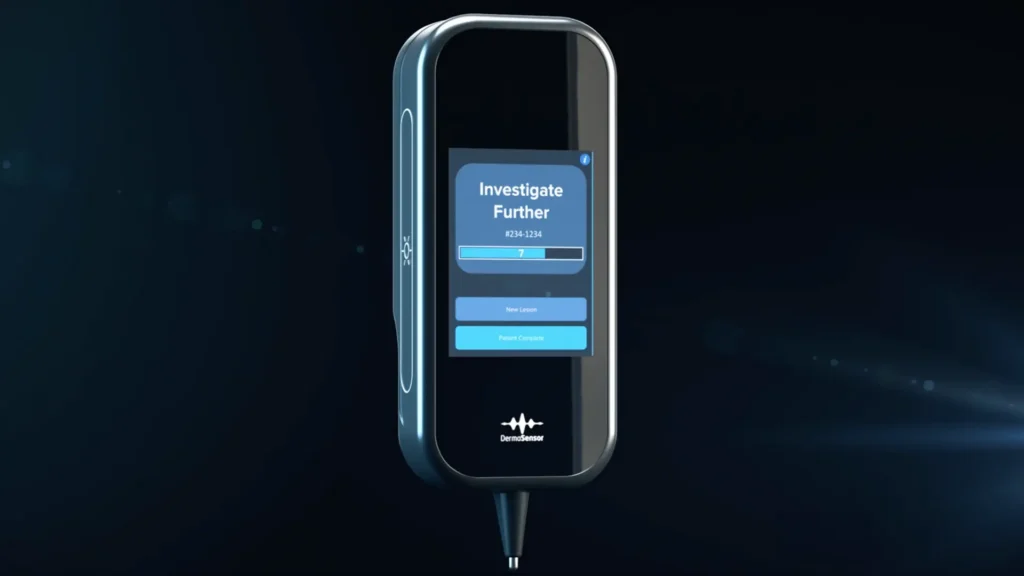
DermaSensor returned an “Investigate Further” result for 92% of lesions and a “Monitor” result for 8%.
No lesion receiving a “Monitor” result was subsequently found to be malignant in this registry. Among lesions with available pathology results, confirmed cancers included squamous cell carcinoma and basal cell carcinoma.
Did Higher DermaSensor Spectral Scores Correspond to Higher Cancer Risk?
Yes. In the Montgomery Medical registry, the malignancy rate increased as DermaSensor spectral scores increased. An “Investigate Further” result from DermaSensor is accompanied by a score from 1 to 10 reflecting the degree of spectral similarity to malignant lesions in studies.1
The Montgomery Medical registry found a clear increase in malignancy rate as scores increased: 0% malignant for scores 1-3, 14% for scores 4-7, and 56% for scores 8-10.
Clinician management also changed as scores increased: further investigation was pursued in 14% of low-score lesions, 61% of moderate-score lesions, and 68% of high-score lesions. The registry authors reported that these patterns suggest the score informed clinical management rather than overriding physician judgment.

How Do the Montgomery Medical Results Compare With DermaSensor’s Published Clinical Evidence?
The Montgomery Medical registry findings are directionally consistent with DermaSensor’s published clinical evidence, and they are practice experience rather than trial evidence.
In the DERM-SUCCESS pivotal validation study, which enrolled 1,579 lesions across 22 primary care sites, device sensitivity was 96.3% in patients aged 40 years and older, the FDA-indicated population, and 95.5% across all ages.1 In the companion multi-reader multi-case utility study, primary care physicians’ management sensitivity increased from 82.0% without the device to 91.4% with it, and their false negative rate decreased by more than half, from 18.0% to 8.6%.3
A single-practice registry does not reproduce the design of a blinded, multi-center clinical trial, and its findings are best read as real-world experience alongside the published studies rather than in place of them.
Where Does DermaSensor Fit in Evaluating Suspicious Skin Lesions?
DermaSensor is designed to provide objective information alongside the physician’s existing clinical assessment.
The handheld device is applied directly to the suspicious lesion and takes five recordings immediately at the point of care, each of which takes a non-invasive sample of lesion tissue. The algorithm analyzes the spectral data and returns one of two results: “Monitor” or “Investigate Further.” An “Investigate Further” result is accompanied by a spectral score from 1 to 10. There is no tissue removal, no incision, and no specimen collection.
The device does not replace visual assessment or physician judgment. Its output is intended to be considered with the totality of clinically relevant information when deciding how a suspicious lesion should be managed.2
For practices considering adoption, the device requires no procedure-room setup and no up-front capital expense, and there are no training seminars or courses needed, just minutes of reading the device Instructions for Use.
Learn more about How DermaSensor Works.
About the Montgomery Medical Clinical Registry
The clinical registry was participated in by Montgomery Medical, Inc. in Smithfield and Brownsville, Pennsylvania, by Marcy Goisse, MD, and Betty Thomas, MD. The analysis compared skin-lesion data and practice metrics from the 12 months before DermaSensor implementation with the subsequent 12 months of device use.
Funding for the registry was provided by DermaSensor Inc. The report analyzed retrospective medical-record data as well as prospective medical-record data following IRB review of the clinical registry.
This registry provides a view of how DermaSensor was used in one primary care practice in routine clinical care. It should be considered alongside DermaSensor’s broader prospective clinical evidence rather than as a substitute for multi-center validation data.
FAQs About DermaSensor Results in a Real-World Primary Care Practice
What results have primary care practices seen with DermaSensor?
In a 12-month clinical registry at Montgomery Medical, a two-physician primary care practice in Pennsylvania, skin cancer diagnoses increased from 2 to 17 (8.5 times), diagnostic yield rose from 2.8% to 28.3%, and average monthly dermatology referrals decreased 33%. These results reflect a single practice’s experience and can vary between practices.
Is the DermaSensor primary care case study a clinical trial?
No. The Montgomery Medical case study is a clinical registry describing real-world experience at a single primary care practice. DermaSensor’s clinical performance is supported by separate prospective, multi-center studies, including the DERM-SUCCESS pivotal validation study.1
How many lesions were evaluated in the DermaSensor primary care registry?
Montgomery Medical evaluated 125 lesions with the DermaSensor device during the 12-month device-use period, in a predominantly older patient population with a mean age of 63 years and 90% of patients aged 40 or older.
What does the DermaSensor spectral score mean?
An “Investigate Further” result from the DermaSensor device is accompanied by a score from 1 to 10 reflecting the degree of spectral similarity to malignant lesions in studies. In the Montgomery Medical registry, the observed cancer rate increased with the score: 0% for scores 1-3, 14% for scores 4-7, and 56% for scores 8-10.
Does using DermaSensor increase dermatology referrals?
Not in the Montgomery Medical registry. Average dermatology referrals decreased 33%, from 1.5 to 1.0 per month, while skin cancer diagnoses increased. This finding reflects one practice’s experience and should not be assumed to apply to every clinical setting. However, studies published in peer-reviewed journals found that the DermaSensor device could have avoided 21-33% of the unnecessary benign biopsies in those studies, while still detecting nearly all skin cancers. To provide more detail, the FDA pivotal study DERM-SUCCESS (>1,000 patients across 22 study centers, led by Mayo Clinic) demonstrated that the device can detect 96% of skin cancers while avoiding 21% of unnecessary biopsies for biopsied lesions suspicious for skin cancer by PCPs. Another validation study, DERM-ASSESS III (10 dermatology study centers, led by Dana Farber/Harvard), showed that the device diagnostic sensitivity and accuracy (i.e. Area Under the Curve) for melanoma matches that of in-person dermatologist with high volumes of skin cancer patients. This study demonstrated that the device correctly diagnosed/detected 96% of melanomas while correctly classifying 33% of benign lesions biopsied by dermatologists, showing the device could help avoid unnecessary care by detecting nearly all melanoma cases while avoiding one-third of unnecessary biopsies.
Does DermaSensor make referral decisions for physicians?
No. The DermaSensor device provides objective information to support a physician’s assessment of a suspicious lesion. The result is used alongside the totality of clinically relevant information, and the physician remains responsible for patient management decisions.
See What DermaSensor Could Add to Your Primary Care Practice
DermaSensor provides an objective skin cancer risk result at the point of care to assist physicians evaluating suspicious skin lesions. See how DermaSensor works, review the broader clinical evidence, or speak with the DermaSensor team about implementation in a primary care practice.
Request a DermaSensor DemoExplore DermaSensor Clinical Evidence
80-0009.31
Indications for Use
The DermaSensor device is indicated for evaluating skin lesions suggestive of melanoma, basal cell carcinoma, and/or squamous cell carcinoma in patients aged 40 and above, to assist in the decision to refer the patient to a dermatologist. The DermaSensor device should be used in conjunction with the totality of clinically relevant information from the clinical assessment, including visual analysis of the lesion, by physicians who are not dermatologists. The device should be used on lesions already assessed as suspicious for skin cancer and not as a screening tool. The device should not be used as the sole diagnostic criterion nor to confirm clinical diagnosis of skin cancer.2
1. Merry SP, Croghan IT, Dukes KA, McCormick BC, Considine GT, Duvall MJ, Thompson CT, Leffell DJ. Primary Care Physician Use of Elastic Scattering Spectroscopy on Skin Lesions Suggestive of Skin Cancer. Journal of Primary Care & Community Health. 2025;16:21501319251344423. doi:10.1177/21501319251344423. Available at: https://doi.org/10.1177/21501319251344423
2. U.S. Food and Drug Administration. De Novo Classification Request: DermaSensor (DEN230008), Decision Summary. Available at: https://www.accessdata.fda.gov/cdrh_docs/reviews/DEN230008.pdf
3. Ferris LK, Jaklitsch E, Seiverling EV, Agresta T, Cyr P, Caines L, Wang N, Siegel DM. DERM-SUCCESS FDA Pivotal Study: A Multi-Reader Multi-Case Evaluation of Primary Care Physicians’ Skin Cancer Detection Using AI-Enabled Elastic Scattering Spectroscopy. Journal of Primary Care & Community Health. 2025;16:21501319251342106. doi:10.1177/21501319251342106. Available at: https://doi.org/10.1177/21501319251342106
Registry data source (not a numbered reference): Goisse M, Thomas B. Clinical Registry Case Study: Assessing the Impact of Integrating DermaSensor into Primary Care for Skin Cancer Management. Montgomery Medical, Inc. Clinical white paper, asset 80.007.2. Funding for this registry was provided by DermaSensor Inc. Registry findings are attributed in page prose and are not carried as numbered clinical references.
