
Clinical Registry Case Study: Assessing the Impact of Integrating DermaSensor™ into Primary Care for Skin Cancer Management Marcy Goisse, MD; Betty Thomas, MD. Montgomery Medical, Inc., Smithfield and Brownsville, PA
The DermaSensor Device
DermaSensor is a validated, FDA-cleared handheld device that non-invasively evaluates skin lesions for
cancer. It captures spectral samples of a lesion and, using a proprietary algorithm, classifies the lesion’s
spectral properties against those of known malignant and benign lesions.
- Validated to detect melanoma, basal cell carcinoma, and squamous cell carcinoma.
- Assesses skin lesions between 2.5 and 15 mm in diameter immediately at the point of care.
- Classifies lesions as “Investigate Further” or “Monitor.”
- A positive “Investigate Further” result is accompanied by a spectral score of 1 to 10, with higher scores
indicating greater similarity to malignant lesions; a negative “Monitor” result indicates no signs of
malignancy. - Published studies found that the device detects 96% of malignant lesions and that use of the device
in clinical decisions reduces mismanaged skin cancers by half.
Real-World Impact: More Cancers Detected, with Greater Diagnostic Efficiency
Drs. Goisse and Thomas reviewed skin-lesion data and metrics for the 12 months prior to implementing
DermaSensor into their practice, compared with a subsequent 12-month period of device use.
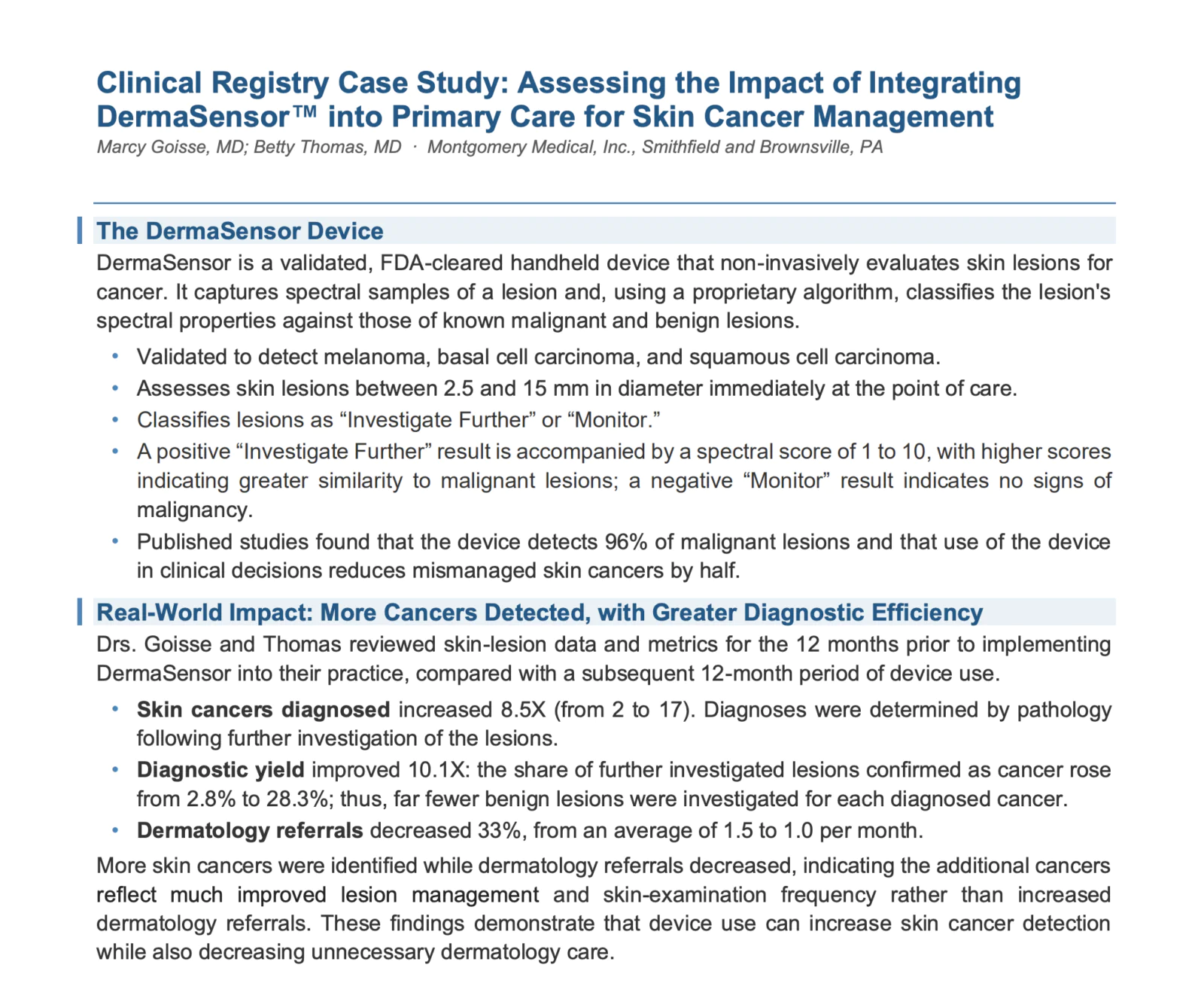
- Skin cancers diagnosed increased 8.5X (from 2 to 17). Diagnoses were determined by pathology
following further investigation of the lesions. - Diagnostic yield improved 10.1X: the share of further investigated lesions confirmed as cancer rose
from 2.8% to 28.3%; thus, far fewer benign lesions were investigated for each diagnosed cancer. - Dermatology referrals decreased 33%, from an average of 1.5 to 1.0 per month.
More skin cancers were identified while dermatology referrals decreased, indicating the additional cancers
reflect much improved lesion management and skin-examination frequency rather than increased
dermatology referrals. These findings demonstrate that device use can increase skin cancer detection
while also decreasing unnecessary dermatology care.
How the Device Was Used and What It Found
Over the device-use period, the practice evaluated 125 lesions with DermaSensor in a predominantly older,
fair-skinned patient population (mean age 63 years; 90% aged 40 or older), consistent with the device’s
cleared indication.
- The device returned an “Investigate Further” result for 92% of lesions and a “Monitor” result for 8%.
- No lesion classified as “Monitor” was subsequently found to be malignant, consistent with the
device’s high published sensitivity of 96%2. - Among lesions with pathology results, confirmed diagnoses included squamous cell and basal cell
carcinoma, the most common skin cancers in this patient population.
Higher Device Scores Signaled Higher Cancer Risk
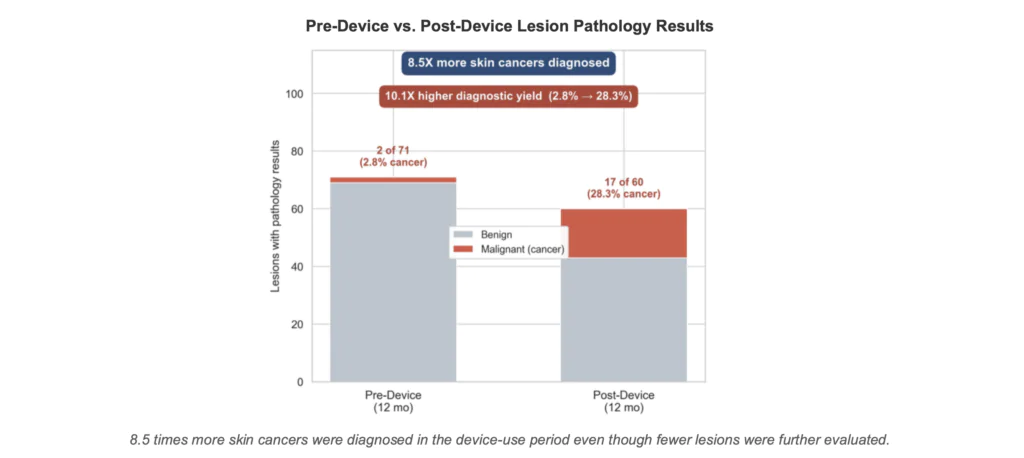
The DermaSensor spectral score demonstrated increasing likelihood of malignancy, consistent with
findings of the two large validation studies that supported FDA De Novo clearance1,2. The cancer rate was
0% for low scores (1 to 3), 14% for moderate scores (4 to 7), and 56% for high scores (8 to 10). Clinicians’
decisions to further investigate tracked the score as well, with further investigation pursued in 14%, 61%,
and 68% of low-, moderate-, and high-score lesions, respectively. Together, these management patterns
and malignancy rates indicate the score meaningfully and effectively informed management rather than
overriding users’ clinical judgment.
Disclosures
Funding for this registry was provided by DermaSensor Inc. This report analyzed retrospective medical-record data as well as prospective medical-record data following IRB review of the clinical registry.
References: 1. Hartman RI, et al. Multicenter prospective blinded melanoma detection study with a handheld elastic scattering spectroscopy device. JAAD Int. 2023;15:24-31. 2. Merry SP, et al. DERM-SUCCESS: Clinical validation of an ESS device in assisting primary care physicians’ detection of skin cancer. J Clin Aesthet Dermatol. 2023;16(4 suppl):S16. 3. Seiverling EV, et al.
Clinical utility of an ESS device in assisting primary care physicians’ detection of cancers. J Clin Aesthet Dermatol. 2023;16. (4 suppl): S16-17. 4. Ferris LK, et al. DERM-SUCCESS FDA Pivotal Study. J Prim Care Community Health. 2025;16:21501319251342106.
