
Can AI Replace a Dermatologist? The Role of AI in Skin Cancer Care
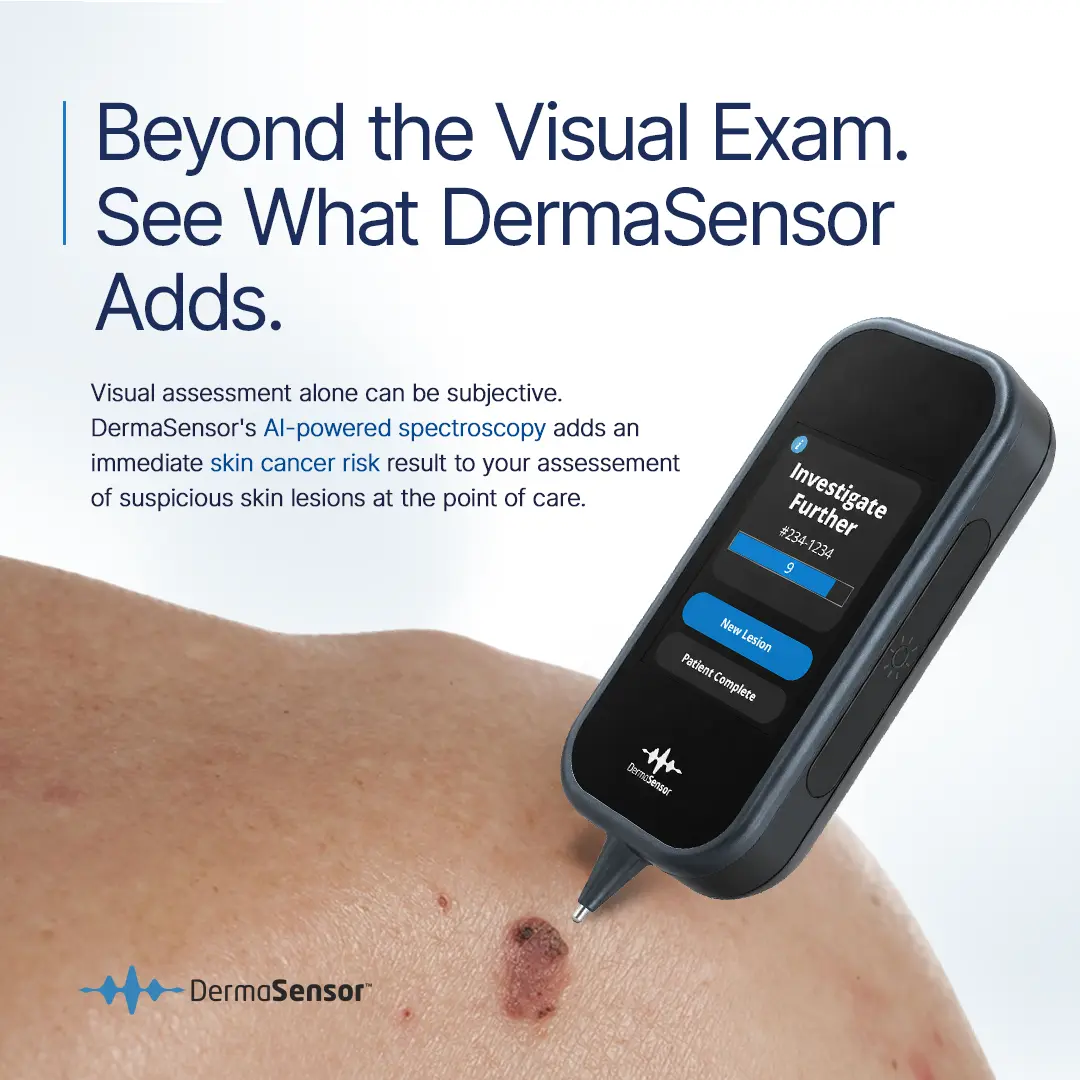
No, and that is not the role of AI in skin cancer care. The opportunity is to use AI to support physicians with additional objective information when assessing suspicious skin lesions, while keeping clinical judgment and clinical expertise at the center of patient care.
DermaSensor is designed to support physicians not already specialized in dermatology in assessing suspicious skin lesions and determining whether dermatology referral should be considered, not to replace dermatologists or specialist care.1
It is a handheld medical device that uses Elastic Scattering Spectroscopy to collect spectral data from a suspicious lesion. A locked, validated AI algorithm analyzes that data and returns an objective skin cancer risk result. AI is one component of the DermaSensor skin cancer detection device; DermaSensor is not an “AI dermatologist.”
Are you a patient looking for a physician offering DermaSensor? Use the DermaSensor Physician Finder.
Quick Facts: Can AI replace a dermatologist?
- AI can support a defined clinical task, but physicians retain responsibility for the patient and the management decision.
- DermaSensor is a medical device that combines spectroscopy with a locked AI algorithm; it is not a generative or autonomous diagnostic system.
- The physician identifies a lesion as suggestive of skin cancer before DermaSensor is used.1
- The device returns “Monitor” or “Investigate Further.” An Investigate Further result includes a 1 to 10 spectral score.1
- The DermaSensor device is not intended to replace clinical decision making.1
- DermaSensor is indicated for use by physicians who are not dermatologists, in patients aged 40 and above, to assist in the decision to refer the patient to a dermatologist.1
AI Support With Demonstrated Clinical Impact
In the DERM-SUCCESS clinical utility study, primary care physicians identified more skin cancers for referral when aided by the DermaSensor device than when unaided. Management sensitivity increased significantly from 82.0% to 91.4% (p=0.003) with device output, so missed cancers decreased by half from 18.0% to 8.6%.2
Why Can AI Not Replace a Dermatologist?
Two published studies showed that DermaSensor had comparable diagnostic sensitivity and accuracy as in-person dermatologists for assessing suspicious lesions. However, AI cannot replace a dermatologist because an algorithm analyzes only the lesion it was used on; while clinical care for skin cancer requires far more than that. Dermatologists examine the whole patient, interpret findings in context, decide when a biopsy or other procedures are needed, consider rare skin cancers, establish treatment plans, and provide follow-up care.
That difference becomes especially clear in the DermaSensor pathway. The device is indicated for use by physicians who are not dermatologists and is intended to assist with the decision about whether a suspicious lesion should be referred to dermatology.1 If referral is needed, a dermatologist remains essential to the next stage of assessment and care.
The FDA is explicit on the point in its De Novo decision summary for the Dermasesnor device: the device is not intended to replace clinical decision making.1 AI can inform a clinical decision. It does not assume responsibility for the patient or replace the expertise required to manage the full care pathway.
What Can AI Help Physicians Accomplish When Assessing Suspicious Lesions?
Four main things: adding objective risk data at the point of assessment, increasing skin cancer detection, minimizing unnecessary care, andsupporting referral prioritization, all at the point of care while the patient is still in the room. AI is most useful in defined, repeatable tasks where objective information is difficult to obtain by eye.
For a non-dermatology physician, that translates into practical support during a routine visit. Elastic Scattering Spectroscopy assesses cellular and subcellular features beneath the surface of the lesion, so the device contributes information that visual inspection alone cannot provide.1 The spectral score attached to an Investigate Further result gives the physician additional information to support referral prioritization.1 Because the result is available at the point of care, the discussion about next steps can often happen during the same visit.
See AI-Supported Skin Cancer Risk Assessment in Action
See how DermaSensor adds objective spectral information to a physician’s assessment of a suspicious lesion.
What Is DermaSensor and How Does It Use AI?
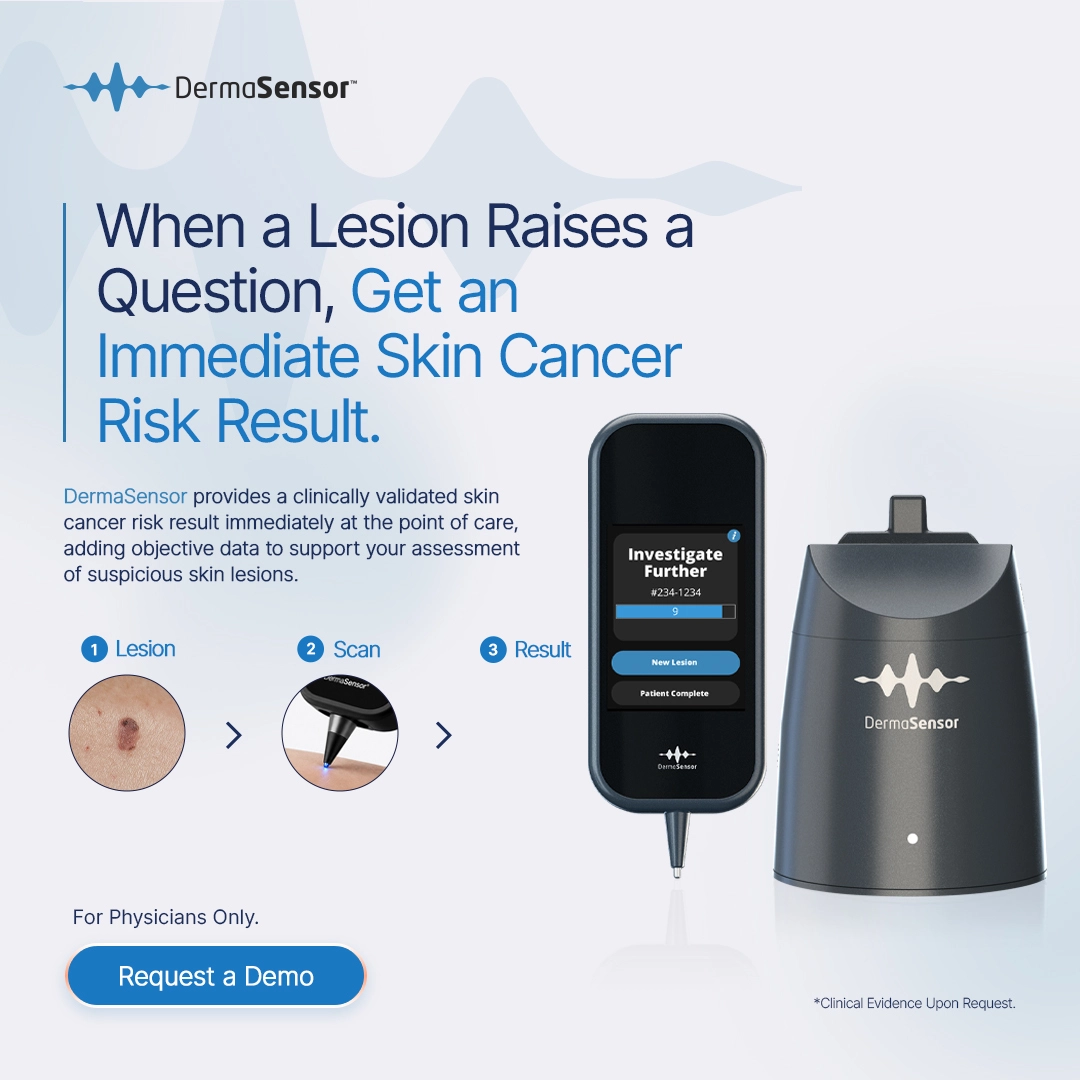
DermaSensor is a handheld, non-invasive skin cancer detection device. It does not use a camera or image analysis. Instead, Elastic Scattering Spectroscopy measures how light scatters from cellular and subcellular structures beneath the surface of a suspicious lesion.
A locked, proprietary AI algorithm analyzes the spectral pattern and returns an immediate, objective skin cancer risk result. The algorithm does not generate a diagnosis, treatment plan, or free-text recommendation, and it does not “learn” or evolve based on continued use.
What Does the DermaSensor AI Do?
The DermaSensor AI performs one defined analytical task within the assessment: it analyzes spectral data from a lesion the physician has already identified as suspicious for skin cancer.
- The physician performs the clinical and visual assessment first.
- The device takes spectral recordings from the selected lesion.
- The algorithm analyzes the spectral pattern based on patterns identified from the spectral training dataset.
- The device returns “Monitor” or “Investigate Further.”
- An Investigate Further result includes a 1 to 10 spectral score that provides additional information for malignancy risk level.
The output is deliberately simple. The result provides additional objective information to support the physician’s assessment; it is not an independent diagnosis. There is more detail on how DermaSensor works here.
What Does the Physician Still Decide When Using DermaSensor?
The physician controls the pathway before, during, and after device use. DermaSensor does not decide which lesion is suspicious, whether the device should be used, or what happens to the patient next.
- Which lesion requires assessment. The physician identifies the suspicious lesion before the device is used.
- Whether DermaSensor is appropriate. The physician determines whether the patient and lesion fall within the indicated use.
- How the result is interpreted. The result is one part of the assessment. The physician also considers what they see on examination, the patient’s history, risk factors and any other relevant findings.
- What happens next. The physician retains the management decision, including whether the lesion should be monitored or referred for further evaluation.
If a patient is referred, specialist assessment, biopsy decisions, diagnosis, treatment, and follow-up remain within the appropriate clinical pathway.1
Can AI-Supported Tools Help Physicians Detect More Skin Cancers?
Yes. In the DERM-SUCCESS clinical utility study, primary care physicians identified more skin cancers for referral when aided by the DermaSensor device than when unaided. Management sensitivity increased significantly from 82.0% to 91.4% (p=0.003), thus physician false negative referrals decreased by half, from 18.0% to 8.6%.2
That does not mean AI made the clinical decision. Physicians assessed the lesion first, then considered the DermaSensor result alongside the visual examination, patient history, risk factors, and other relevant clinical information. The physician remained responsible for deciding what happened next. The value of AI here is the additional objective information available at the point of decision, supporting an assessment the physician is already making.
See What an Immediate Skin Cancer Risk Result Looks Like
Book a device demo to see how DermaSensor provides an objective skin cancer risk result to support suspicious lesion assessment at the point of care.
Can AI Help Strengthen the Referral Pathway Between Primary Care and Dermatology?
Yes, by supporting better decisions earlier in the pathway. Access to a dermatologist can be difficult to obtain, and around 40% of the United States population lives in an area with limited access to a dermatologist.2 When primary care physicians have additional objective information to support suspicious lesion assessments, it may help inform referral decisions and prioritize patients who need dermatologic evaluation.
More targeted referral decisions can also help protect limited dermatology capacity. When higher-risk lesions can be prioritized more clearly, specialist time can remain focused on patients who need dermatologic evaluation and treatment most. This is one reason the device is used in primary care settings rather than in place of them.
Clinical Expertise, Supported by Objective Data
Add Objective Information Without Replacing Clinical Judgment. See how DermaSensor can support physicians with an objective skin cancer risk result at the point of care.
FAQs About AI, Dermatology and DermaSensor
Can AI replace a dermatologist?
No. AI can support defined analytical tasks, but it does not replace the full clinical role of a dermatologist, including patient examination, clinical judgment, procedures, treatment planning, and follow-up. DermaSensor specifically supports non-dermatology physicians with referral decision-making; it is not a substitute for specialist care1.
Is DermaSensor an AI dermatologist?
No. DermaSensor is a handheld medical device that uses spectroscopy to collect lesion data and a locked AI algorithm to analyze it. The algorithm is one component of the device, and it returns “Monitor” or “Investigate Further” rather than a diagnosis.
Can AI improve physician performance?
Yes. In the DERM-SUCCESS clinical utility study, primary care physician management sensitivity improved from 82.0% to 91.4% when DermaSensor results were available, thus false negative referrals decreased by half from 18.0% to 8.6%2.
Does the DermaSensor AI choose which lesion should be assessed?
No. The physician performs the clinical examination first and identifies the lesion as suspicious before DermaSensor is used1.
Does the DermaSensor algorithm keep learning from patients?
No. The current algorithm is locked and does not learn or evolve based on continued use, so device performance stays consistent with what was validated across various clinical studies.
What role does a dermatologist still play after a DermaSensor result?
When a lesion requires further evaluation, dermatology remains part of the care pathway for specialist assessment and appropriate diagnostic and treatment decisions.
80-0009.30.
Indications for Use
The DermaSensor device is indicated for evaluating skin lesions suggestive of melanoma, basal cell carcinoma, and/or squamous cell carcinoma in patients aged 40 and above, to assist in the decision to refer the patient to a dermatologist. The DermaSensor device should be used in conjunction with the totality of clinically relevant information from the clinical assessment, including visual analysis of the lesion, by physicians who are not dermatologists. The device should be used on lesions already assessed as suspicious for skin cancer and not as a screening tool. The device should not be used as the sole diagnostic criterion nor to confirm clinical diagnosis of skin cancer.
- U.S. Food and Drug Administration. De Novo Classification Request: DermaSensor (DEN230008). Decision Summary. January 12, 2024. Available at: https://www.accessdata.fda.gov/cdrh_docs/reviews/DEN230008.pdf
- Ferris LK, Jaklitsch E, Seiverling EV, et al. DERM-SUCCESS FDA Pivotal Study: A Multi-Reader Multi-Case Evaluation of Primary Care Physicians’ Skin Cancer Detection Using AI-Enabled Elastic Scattering Spectroscopy. Journal of Primary Care & Community Health. 2025;16:21501319251342106. doi:10.1177/21501319251342106. Available at: https://doi.org/10.1177/21501319251342106
