
Closing the Gap: How Primary Care Can Reduce Missed Skin Cancers with DermaSensor
Every May during Skin Cancer Awareness Month, patient questions about moles and spots surge in primary care. The timing is a useful reminder of a year-round challenge: skin cancers that slip past visual assessment in a short primary care visit.
Most patients take a suspicious lesion to their family medicine or internal medicine physician first, not to a dermatologist. That makes primary care the true front line of skin cancer detection, and it creates the gap between what a PCP can see in an appointment and what a dermatologist would catch.
This article looks at the scale of that gap, why it exists, and what the published evidence shows about closing it.
The diagnostic challenge primary care physicians face
Primary care physicians see a high volume of patients with skin concerns, with over 20% of primary care visits involving skin conditions1. A patient points at a mole that has changed, a suspicious lesion that will not heal, a patch of rough skin they have been watching. The appointment is short. The differential is broad. Most clinicians are not trained on the use of dermatoscopes, and formal dermatology training is not part of most family medicine or internal medicine residencies.
The task is to decide whether a lesion requires further evaluation or can be monitored. That decision is often made with visual inspection alone, and the consequences of getting it wrong run in both directions. An unnecessary referral adds to the dermatology backlog and to patient costs. A missed cancer delays treatment.
How many skin cancers go missed in primary care?
In a companion clinical utility study with 108 physicians, researchers found that use of the ESS device significantly enhanced physicians’ ability to identify and correctly refer skin cancers and improved their overall skin lesion management accuracy. PCPs correctly referred 91.4% of malignant lesions when aided by the device, compared to just 82.0% without it – a 50% reduction in missed cancer referrals (from 18.0% to 8.6%)2
“I have spent most of my career researching and using skin cancer diagnostic tools. It has been a long-time unaddressed goal of the dermatology and primary care communities to have an easy-to-use tool that can provide an automated risk assessment for suspicious lesions.” said Laura Ferris, MD PhD, who is the Chair of Dermatology at UNC Chapel Hill, the lead author of this utility study, and a leading researcher on skin cancer diagnostic tools. “Now that DermaSensor is the first such tool available for PCPs and, given the clear device benefits that our study and others have demonstrated, I am optimistic for the impact this device will have on skin cancer detection and care.” – Dr. Ferris
Why is skin cancer risk hard to spot with visual assessment alone
A handful of structural factors compound the difficulty.
A full skin evaluation competes against chronic disease management, preventive care, and whatever else brought the patient in. A suspicious lesion may need to be assessed immediately.
Access to a specialist is not always available to patients. Wait times for a new dermatology appointment commonly run into weeks or even months, particularly outside major urban cities. Over 60% of counties in America do not have a dermatologist.
Training varies. Most physicians receive a brief rotation in dermatology during residency and rely on pattern recognition built up in practice. The American Academy of Family Physicians lists skin cancer detection in family medicine training, but access to that training is uneven, and many physicians report a lack of confidence in their ability to handle suspicious lesions.
The result is a system that leans heavily on patient self-reporting and PCP visual judgment, without an objective assessment at the point of care.
Skin cancer detection tools that help PCPs close the gap
Over the past decade, several technologies have been developed to support PCP assessment of skin cancer. Dermoscopy helps but requires extensive training. Teledermatology helps, but does not provide a real-time answer. Image-based consumer apps have proliferated but none are validated for clinical use nor authorized by the FDA.
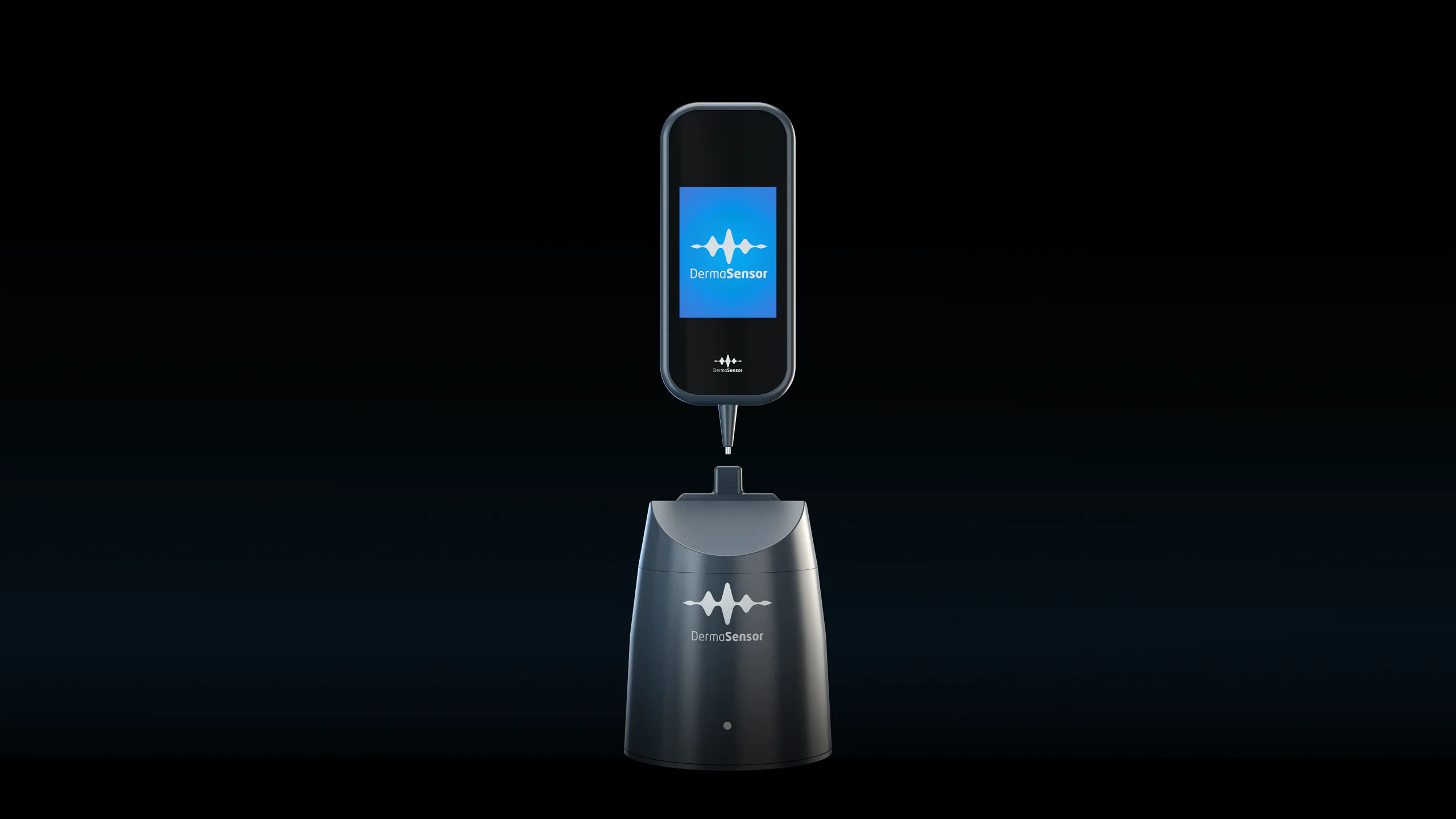
A more recent category is point-of-care optical assessment. The DermaSensor device, an FDA Cleared handheld instrument, uses Elastic Scattering Spectroscopy (ESS) to record optical information from tissue beneath a suspicious lesion and return an objective risk result on the device screen. DermaSensor is designed specifically for use by physicians who are not dermatologists to assist in the decision to refer a patient to a dermatologist.
The clinical question is whether tools like this actually change PCP performance. The published evidence answers that question.
What the evidence actually shows
Three findings from the published pivotal studies of the DermaSensor device speak directly to closing the gap.
First, device sensitivity for skin cancer detection:
In the DERM-SUCCESS pivotal clinical validation study, the device correctly identified 96% of malignant lesions. The Negative Predictive Value (NPV) was 96.6% and the Positive Predictive Value (PPV) reached 61% for the highest risk result of 10.3
Second, the impact on PCP referral decisions:
In the DERM-SUCCESS pivotal clinical utility study, PCPs correctly referred 91.4% of malignant lesions when aided by the device, compared to just 82.0% without it – a 52% reduction in missed cancer referrals (from 18.0% to 8.6%)2.
Third, physician experience with the device:
In the JCAD multi-reader multi-case clinical utility study of 118 PCPs, 91.5% of study physicians agreed the device added value to their clinical care4. 75% agreed it would help them detect more skin cancers4, and 71% reported increased confidence in evaluating skin lesions4.
Taken together, these findings describe a meaningful shift. With an objective risk result available at the point of care, the proportion of malignant lesions being missed in a primary care setting dropped by roughly half. That is the gap closing, in numbers.
A moment to act: Skin Cancer Awareness Month
Skin Cancer Awareness Month, observed each May and kicked off by Melanoma Monday on the first Monday of the month, is when patient demand for skin checks is highest.
It is a natural moment for a primary care practice to evaluate the tools it has for assessing suspicious lesions, and to think honestly about whether the current workflow is catching everything it should be.
During May 2026, DermaSensor is waiving the one-time device setup and activation fee for qualifying primary care practices that activate during Skin Cancer Awareness Month. See the May 2026 offer.
Frequently asked questions
How many skin cancers are missed in primary care?
In the DERM-SUCCESS pivotal study2, using the device alongside a clinician’s visual exam significantly improved their ability to detect and act on concerning lesions.
- Diagnostic accuracy improved from 71% to 82%
- Accurate referrals increased from 82% to 91%
Why are primary care physicians less accurate at skin cancer detection than dermatologists?
Dermatology training is limited in most family medicine and internal medicine residencies. Only approximately 16% of primary care clinics say they have access to a dermatoscope or have had training5. Point-of-care diagnostic tools like DermaSensor are designed to narrow that performance gap by providing skin cancer risk detection results alongside the clinician’s visual assessment.
What tools help primary care physicians detect skin cancer?
Dermoscopy, teledermatology, and point-of-care optical assessment devices are the main categories. Dermoscopy improves accuracy but requires extensive training and fully relies on the clinician’s subjective assessment. Teledermatology e-consults provide specialist input but introduces delay and additional communication steps (PCP to dermatologist, dermatologist to PCP, and then PCP to patient). The FDA Cleared DermaSensor device provides an immediate skin cancer risk assessment during the visit, so the referral decision can be made with the patient still in the room. Providing your patients with peace of mind.
Why is Skin Cancer Awareness Month significant for primary care practices?
Patient interest in skin checks is highest in May due to awareness campaigns around Skin Cancer Awareness Month and Melanoma Monday, which typically drive a rise in primary care appointments where patients bring up a suspicious mole or spot. That makes May a practical moment to review how your practice assesses suspicious lesions and how adding a point-of-care device adds value to patient clinical outcomes and differentiates your practice. Patients love DermaSensor.
See what they are saying (include the patient testimonial video.
https://www.youtube.com/shorts/6cnnBMFvCK4
Ready to close the gap in your practice?
See how DermaSensor fits into a typical primary care workflow, review the clinical evidence, and find out whether your practice qualifies for the May 2026 Skin Cancer Awareness Month activation offer.
1. Gomez YS, Zadeh FZ. An Approach to Skin Conditions Assessment in a Family Medicine Residency Health Center. J Family Med Community Health. 2025;12(2):1212. https://www.jscimedcentral.com/jounal-article-info/Journal-of-Family-Medicine-and-Community-Health/An-Approach-to-Skin-Conditions-Assessment-in-a-Family-Medicine-Residency-Health-Center-12257
2. Ferris LK, Jaklitsch E, Seiverling EV, et al. DERM-SUCCESS FDA Pivotal Study: A Multi-Reader Multi-Case Evaluation of Primary Care Physicians’ Skin Cancer Detection Using AI-Enabled Elastic Scattering Spectroscopy. J Prim Care Community Health. 2025;16:21501319251342106. https://journals.sagepub.com/doi/full/10.1177/21501319251342106
3. Merry SP, Croghan IT, Dukes KA, McCormick BC, Considine GT, Duvall MJ, Thompson CT, Leffell DJ. Primary Care Physician Use of Elastic Scattering Spectroscopy on Skin Lesions Suggestive of Skin Cancer. J Prim Care Community Health. 2025;16:21501319251344423. doi:10.1177/21501319251344423. https://pmc.ncbi.nlm.nih.gov/articles/PMC12144386/
4. Seiverling, E.V. (2025). JCAD MRMC Study. Journal of Clinical and Aesthetic Dermatology, October 2025, 58–65. https://jcadonline.com/enhancing-diagnostic-precision-melanoma-evaluation/
5. Morris JB, Alfonso SV, Hernandez N, Fernandez MI. Perspectives on Dermoscopy in the Primary Care Setting. J Am Board Fam Med. 2020;33(6):1022–1027. doi:10.3122/jabfm.2020.06.200238. https://pubmed.ncbi.nlm.nih.gov/33219084/
