
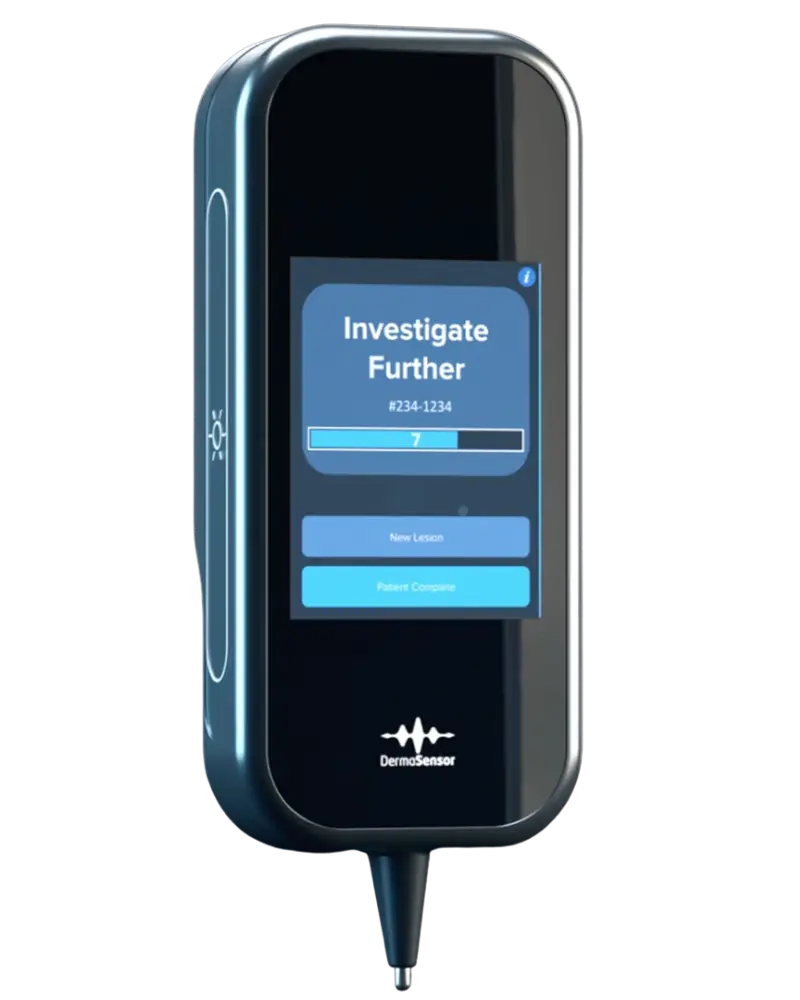
DermaSensor: A Skin Cancer Detection Device
Skin cancer is the most common type of cancer in the United States, with basal cell carcinoma (BCC) and squamous cell carcinoma (SCC) being the most common types, followed by melanoma.
DermaSensor™ is an FDA Cleared, AI-powered skin cancer risk detection device designed for use by physicians in clinical settings. It provides objective information to assist in evaluating skin lesions suspicious of melanoma, basal cell carcinoma, and/or squamous cell carcinoma.
Learn how it works in real clinical settings and explore the supporting clinical evidence.
Quick Facts About Our FDA Cleared Skin Cancer Risk Detection Device:
FDA clearance
First FDA cleared skin cancer detection device developed for physicians.
All three skin cancers
First FDA cleared automated device indicated for all three common skin cancers (Melanoma, BCC, and SCC).
Only FDA-cleared AI device for PCPs
Only FDA cleared AI skin cancer risk device for primary care physicians.
Device sensitivity
96% overall device sensitivity for evaluating all three common skin cancers.
Melanoma sensitivity
Device melanoma sensitivity (95.5%) similar to that of expert dermatologists (90.9%).*
Negative predictive value
Overall NPV of the device was 96.6%, meaning a negative "Monitor" device result had a 3.4% chance of being malignant.*
Non-invasive
Non-invasive, point-and-click spectral recordings.
*Clinical evidence upon request.
What Is DermaSensor?
DermaSensor™ is a skin cancer risk detection device that is indicated for use as an objective tool to assist physicians in evaluating skin lesions suggestive of melanoma, basal cell carcinoma, and/or squamous cell carcinoma.
The DermaSensor device is intended to assist physicians in deciding whether suspicious skin lesions require further clinical care and is not intended to be used for direct diagnosis of skin cancer.
The device provides physicians with objective information designed to help inform clinical decision-making.
*This skin cancer risk detection device is not intended for at-home or personal use.
Ready to See DermaSensor in Action?
How Our AI Skin Cancer Detection Device Works
DermaSensor uses Elastic Scattering Spectroscopy (ESS), an optical tissue sampling technique that distinguishes between normal and abnormal tissue in vivo without the need for tissue removal.
How it scans
The handheld ESS device measures spectra of skin lesions and uses an algorithm to classify the lesion’s scanned properties against those of known malignant and benign lesions.
Device output
The output of the ESS classifier is: “Investigate Further” or “Monitor”.
For “Investigate Further” classified lesions, a score from 1 to 10 is provided, which corresponds to the degree of spectral similarity a lesion has to malignant lesions in studies, with 10 representing the highest degree.
Algorithm validation
The algorithm has been trained and validated with over 20,000 spectral scans from over 4,500 skin lesions, including histologically confirmed melanoma, BCC, SCC, and benign lesions, as well as unbiopsied benign lesions diagnosed by board-certified dermatologists.
Immediate results
Immediate, objective results are provided to augment the physician’s management decision.
*This skin cancer risk detection device is not intended for at-home or personal use.
See the Clinical Evidence Behind DermaSensor
Clinical Performance of the DermaSensor Skin Cancer Detection Device
DermaSensor has been evaluated in prospective, multi-center clinical studies.
DERM-SUCCESS: Primary Care Study
The DermaSensor device is an easy-to-use, point-of-care, hand-held skin cancer adjunctive diagnostic device with high sensitivity and NPV to help inform PCP decision-making about skin lesions suspicious for cancer that need further evaluation and those that may be monitored. Coupled with clinical exam findings, this device may aid PCPs to improve clinical decisions about suspicious skin lesions (i.e., to refer, or monitor), with this study suggesting device use could rule out 20.7% of suspicious lesions from needing further evaluation. With the device PPV reaching as high as 61%, the device can also help inform which lesions merit urgent evaluation by dermatologists.
- DermaSensor demonstrated high sensitivity of 95.5% in detecting all skin cancer types when compared to the gold standard of histopathologic examination, with similar sensitivity and specificity across all Fitzpatrick skin type subgroups.
- NPV of the device was 96.6%, meaning a negative "monitor" device result had only a 3.4% chance of being a false negative, i.e. any of the three cancer types.
- The overall positive predictive value (PPV) for an "investigate further" result was 16.6% (NNB of 6:1).
- The device sensitivity and overall accuracy (i.e. AUC) were both found to be superior to those of the PCPs.
- By pairing high sensitivity with clinical exam findings, the device may rule out 20.7% of lesions from needing further evaluation, reducing patient anxiety and optimizing healthcare resource allocation.
- Likelihood of malignancy increased significantly with increasing spectral scores. For scores of 1-3, PPV was 6%, which increased to 18% for scores of 4-7 and 40% for scores of 8-10.
*Clinical Evidence Upon Request
DERM-ASSESS III: Dermatology Study
Ten dermatology study centers, across the US and Australia, scanned lesions that they found concerning for melanoma. All dermatologists were blinded to the device results. Gold standard comparison for performance of the device and dermatologists was the biopsy result with multiple dermatopathologist review when consensus was not reached during the primary review process. High resolution digital images and the patient's clinical information, including prior skin cancer history, risk factors and physical exam results, were recorded for each case. After clinical evaluation, dermatologists reported their diagnosis and confidence level, which provided the physician comparison data. The results evaluated were sensitivity, specificity, Negative Predictive Value for melanoma, melanoma + severely atypical nevi, and all high-risk lesions. Area Under the Curve (AUC) was also calculated and modeled and compared between the study dermatologists and the device performance.
The 10 dermatology study centers biopsied all lesions that were suspicious of melanoma based on their standard of care clinical and dermoscopic assessment and decision making.
- DermaSensor was able to identify 96% of melanomas when compared to dermatopathology consensus results (at least two dermatopathologists reviewed each high-risk melanocytic lesion case); for both melanomas and several atypical nevi, the device sensitivity was 91%.
- Overall device specificity was 33%, thus DermaSensor could have effectively ruled out 33% of benign biopsied lesions as benign while detecting 96% of melanomas.
- The overall negative predictive value (NPV) for a "monitor" result was 98% for melanoma, i.e. a negative result had less than a 2% chance of being melanoma. The positive predictive value (PPV), i.e. the likelihood a lesion was melanoma for a positive "Investigate further" result was 10% for low 1-3 scores (NNB of 10:1), 21% for mid 4-7 scores (NNB of 5:1), and 47% for high 8-10 scores (NNB of 2.1:1).
- The overall device accuracy (i.e. Area Under the Curve or AUC) of 0.76 was comparable to that of 0.75 for the Dermatologists.
*Clinical Evidence Upon Request
A Skin Cancer Detection Device Designed for Clinical, Point-of-Care Use
DermaSensor empowers physicians by providing objective, actionable results to aid in skin cancer risk detection by assessing cellular and sub-cellular features that cannot be seen visually or dermoscopically.
The device provides:
- Non-Invasive, point-and-click spectral recordings
- Immediate, objective results
- Software updates are sent to the device from DermaSensor’s server as they become available
- Remote device functionality monitoring
- Cloud-based data synchronization via secure Wi-Fi connection
Easy to Learn and Use: No training seminars or courses needed, just minutes of reading the device’s instructions for use.
Ready to Add DermaSensor to Your Practice?
*First FDA cleared skin cancer device developed for PCPs
*First FDA cleared automated device indicated for all three common skin cancers
Important Safety Information
The DermaSensor skin cancer detection device is:
Intended to act as an adjunctive tool for lesions that are suspicious of melanoma or non-melanoma skin cancer (NMSC).
Intended for use only by physicians appropriately trained in the assessment of skin lesions for cancer.
Not intended for direct diagnosis of skin cancer
If you have concerns about a suspicious skin lesion, consult a licensed healthcare provider.
Skin Cancer Risk Detection Device - FAQs
Frequently Asked Questions
What is a skin cancer risk detection device?
A skin cancer risk detection device is a medical tool used by physicians to help evaluate skin lesions that may be cancerous. The DermaSensor™ device is an FDA Cleared skin cancer risk detection device designed to assist clinicians in evaluating suspicious lesions.
Is DermaSensor FDA cleared?
Yes. DermaSensor is an FDA Cleared skin cancer risk detection device. It is indicated to assist physicians in evaluating lesions suggestive of melanoma, basal cell carcinoma, and squamous cell carcinoma.
Can DermaSensor be used to diagnose skin cancer?
No. The DermaSensor device is not intended to be used for direct diagnosis of skin cancer. It provides objective information to assist physicians in deciding whether a lesion requires further clinical care, such as referral to a dermatologist.
How accurate is the DermaSensor skin cancer detection device?
In a prospective, multi-center primary care study, the device demonstrated an overall 96% sensitivity for evaluating skin cancer risk. DermaSensor provides objective results supported by validated clinical studies.
Can an AI skin cancer detection device detect melanoma?
Yes. The DermaSensor device is indicated to assist in evaluating lesions suggestive of melanoma, and in clinical studies demonstrated 96% sensitivity for melanoma detection. It provides objective information to support clinical decision-making.
Is DermaSensor a non-invasive skin cancer scanner?
Yes. The device takes non-invasive spectral recordings of a lesion without removing tissue. DermaSensor uses Elastic Scattering Spectroscopy (ESS) technology to evaluate suspicious lesions at the point of care.
Who can use DermaSensor?
DermaSensor is only for use by physicians appropriately trained in the assessment of suspicious skin lesions for cancer. It is not intended for consumer or at-home use.
What is the risk of using DermaSensor?
DermaSensor should be used in conjunction with the totality of clinically relevant information from the clinical assessment, including visual analysis of the lesion, by physicians who are not dermatologists. The device should be used on lesions already assessed as suspicious for skin cancer and not as a screening tool. The device should not be used as the sole diagnostic criterion nor to confirm clinical diagnosis of skin cancer. It is not intended for consumer or at-home use. The primary risks of DermaSensor are that false negative results (e.g., when a test indicates that a condition is absent when it is actually present) could lead to failure to treat cancer and cancer progression, or false positive results (when a test indicates that a condition is present when it is actually absent) could lead to unnecessary referrals and/or medical procedures. For a complete list of risks, please see the DermaSensor instructions for use.
Get Started With DermaSensor
Request a demo to see how DermaSensor supports clinicians in evaluating suspicious skin lesions.